How to Choose a Diesel Injector Test Bench
Compare injector coverage, bench layout, software, reports and the complete job cycle, with photographs from the Injectune demonstration and production area.
Injectune Editorial
7 min read
Updated
A diesel injector test bench should be selected around the injectors and services your workshop actually handles. Confirm the exact application coverage, the measurements and coding procedures you need, the complete testing workflow and the cost of keeping the equipment supported. Maximum rail pressure and the number of channels are useful specifications, but neither is a complete buying decision.
This guide is for workshops comparing common rail injector testing equipment. It provides a purchasing checklist, explains where headline specifications can be misleading and shows how to compare the documented Injectune X1 and X4 configurations.
Evaluate the bench and workstation as one working area
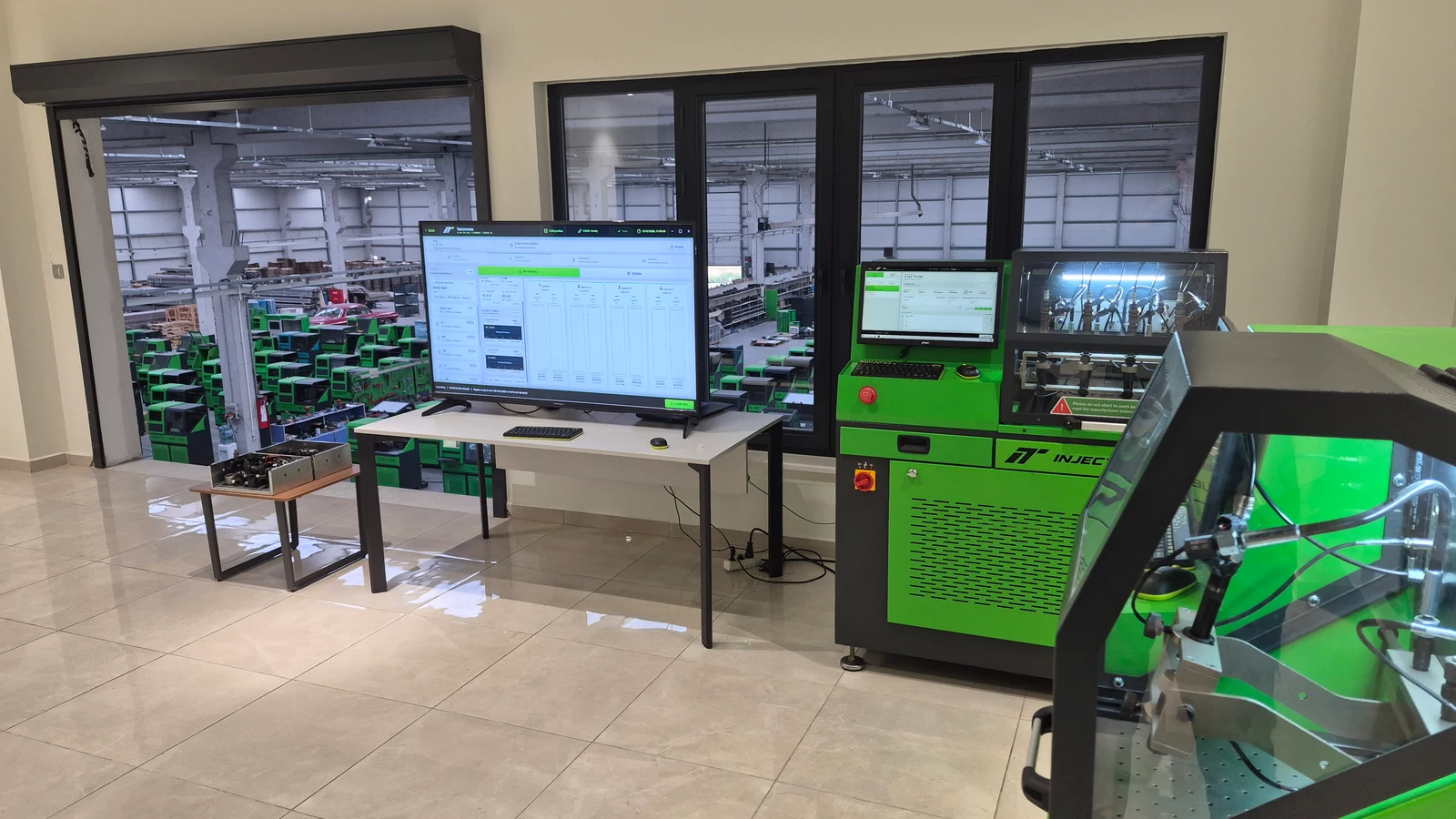
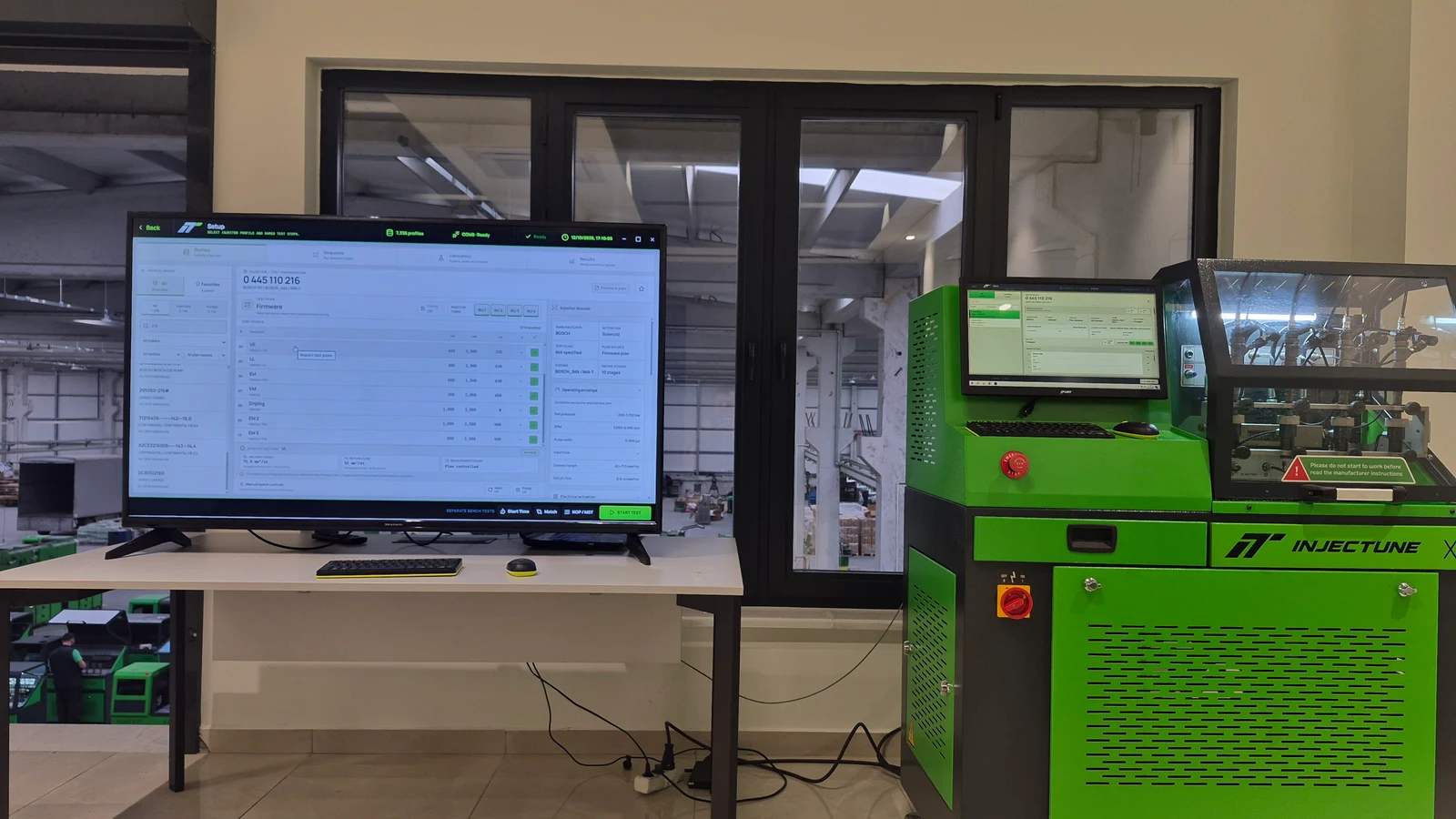
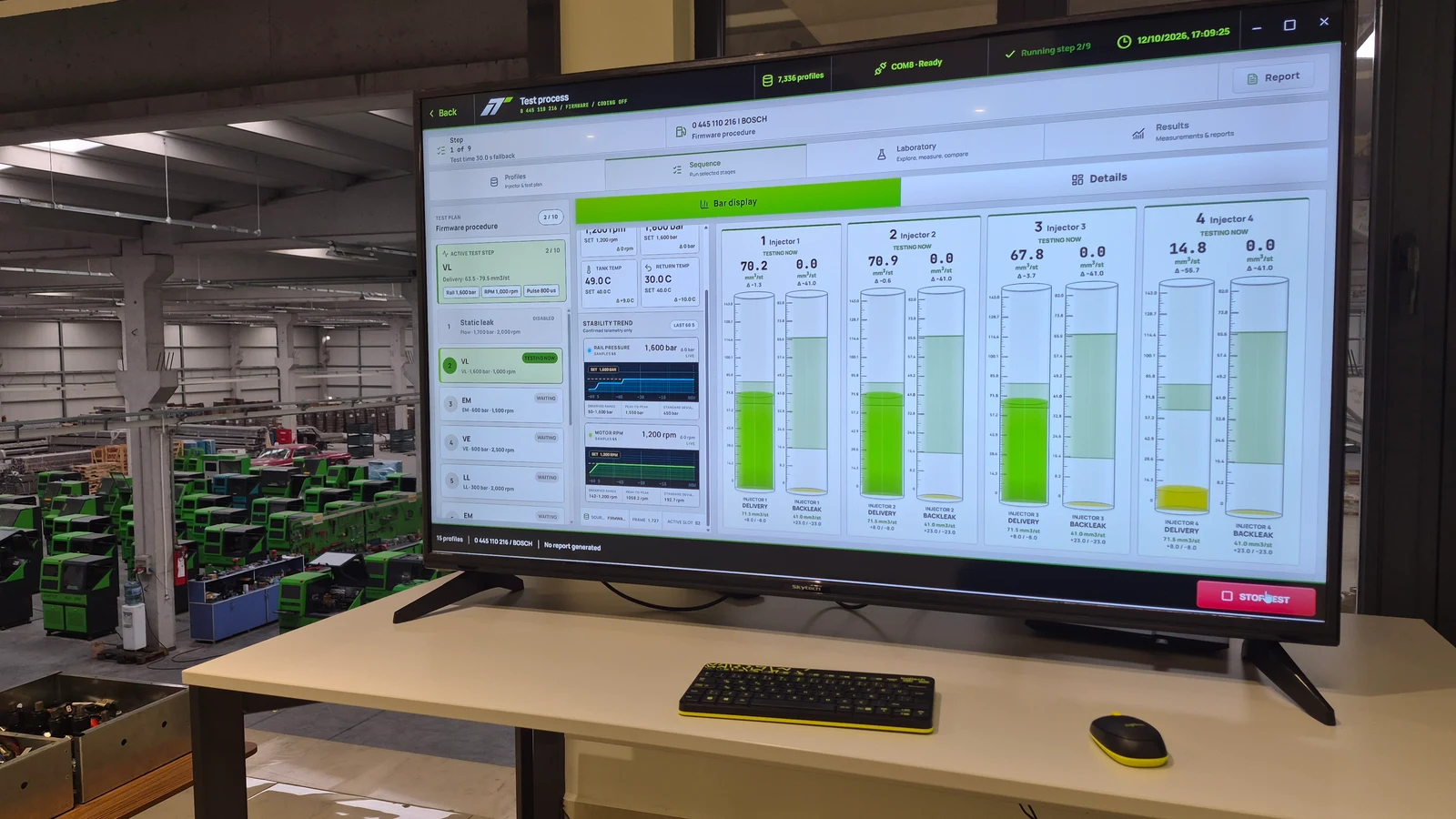
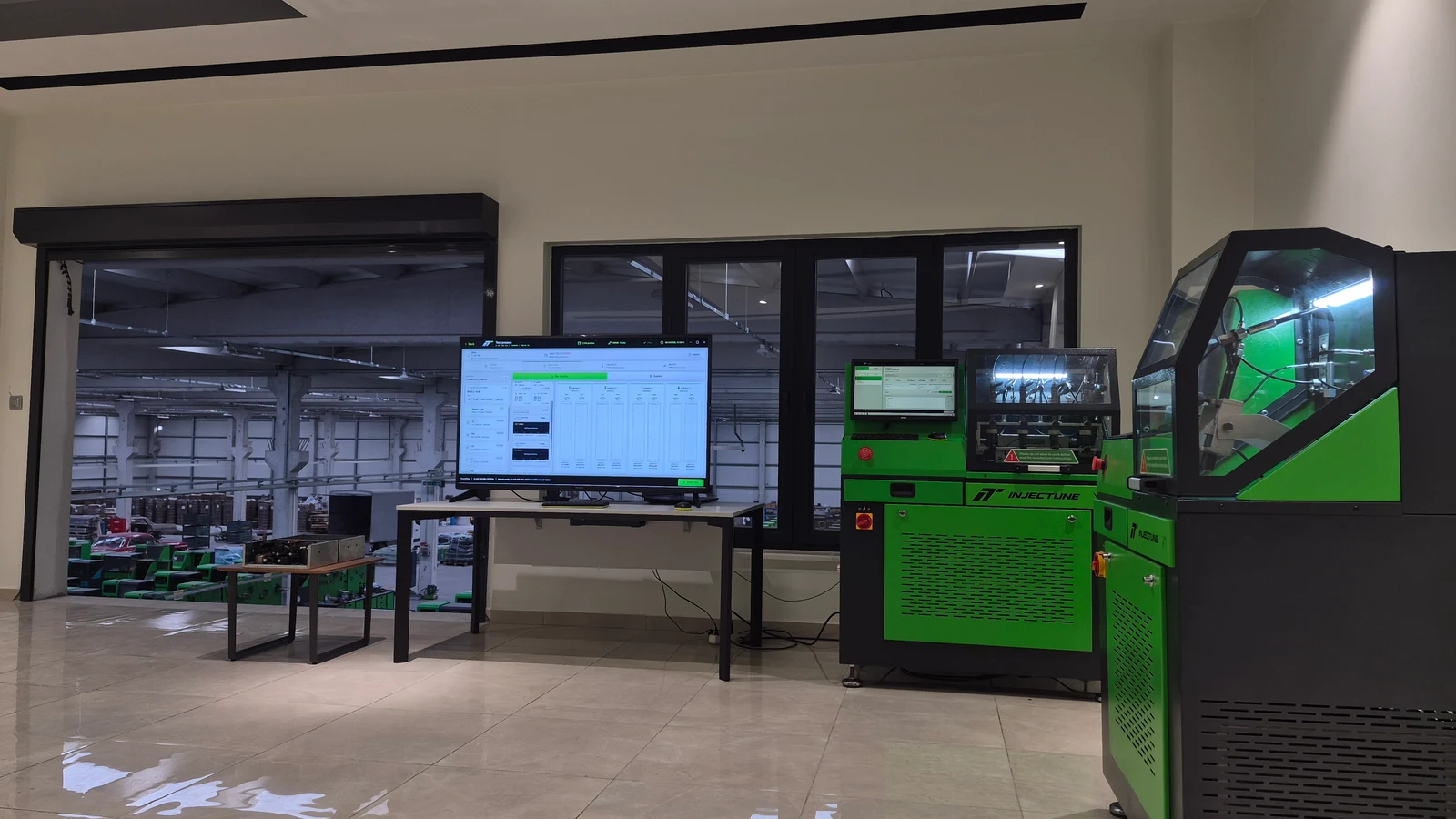
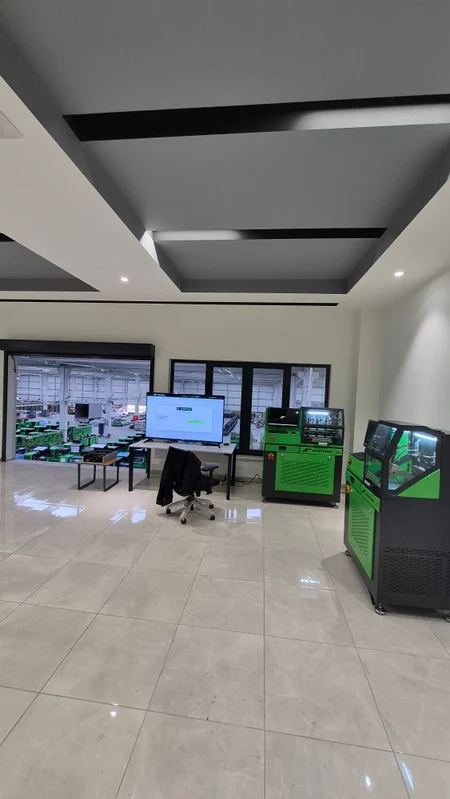
The supplied Injectune photographs show test benches, a separate software display and the production area beyond the windows. Use a demonstration to follow a representative job from injector identification to a saved report. Check where the operator prepares the component, reads the screen and handles the finished job. This makes layout and software usability part of the equipment decision alongside application coverage and measurements.
Start with the work you intend to accept
Before requesting a quotation, prepare a representative list of injector part numbers from your recent jobs. Include the work you currently outsource and the applications you expect to service next. Ask the supplier to assess that list against the proposed configuration.
Separate the services you plan to sell:
| Workshop service | Evidence to request before buying |
|---|---|
| Diagnose an injector removed from a vehicle | The correct test sequence, measurements and acceptance limits for that part number |
| Test a complete injector set | A demonstration showing setup, individual results and identification of every injector |
| Verify an injector after repair | The repair procedure, final test requirements and a traceable report |
| Generate a supported correction code | The exact code family, software function, application coverage and example output |
| Expand into another injector family | A written list of additional fixtures, cables, software and training |
This turns “Does it test Bosch or DENSO?” into a more useful question: “Can this configuration perform the service I need on these specific injectors?”
Match the entire test system to the injector
Common rail compatibility includes the electrical drive, hydraulic connections, return circuit, required test conditions and software data. A connector that fits is only one part of that chain.
As an industry example, Bosch's DCI 200 documentation lists VCC/NCC technology, automatic backflow pressure control and application accessories separately. It also identifies combinations of third-party kits and data licences. That is a useful reminder to request coverage at the application level, rather than treating a brand name as a complete compatibility statement. Bosch DCI 200 brochure.
Use the injector profile database to prepare your application list. Then verify the actual test and coding functions with the supplier. A catalogue entry is a starting point for identification, not a substitute for confirming the installed test plan.
Look beyond the maximum pressure rating
Ask which pressure and pulse conditions the required test plan uses, and whether the bench can run the complete sequence with the appropriate connections and fluid conditions. A higher pressure ceiling cannot compensate for missing application data or an unsuitable drive configuration.
Pressure and flow capacity also need to be considered together. Hartridge describes its CRi-Pro platform in terms of both the higher pressure and higher flow requirements of modern injectors. The purchasing implication is to demonstrate your demanding applications, not to compare the largest number on each brochure. Hartridge CRi-Pro.
Avoid asking an operator to improvise a high-pressure demonstration. Have the supplier use the approved procedure, rated connections and normal safety protections for the selected injector.
Evaluate measurement control and repeatability
During a demonstration, request the actual readings and units, the selected test conditions and the permitted limits. Ask how the equipment controls fluid temperature, how its measurement system is checked and what maintenance is required to keep results comparable.
Temperature management also affects productive time. Hartridge's HJ085 upgrade is designed to maintain its specified tank temperature and reduce cooling downtime on the applicable machines. Its stated temperature is a feature of that system, not a universal setting to copy into another bench. Hartridge HJ085 temperature management.
A practical acceptance exercise is to repeat the same approved sequence on an identified reference injector after normal preparation. Review the recorded conditions and results with the supplier. Do not invent a universal acceptable variation: agree the acceptance criteria for the equipment and test method in advance.
For a closer explanation of delivery, return quantity and response measurements, read our common rail test-plan and report guide.
Confirm testing and coding as separate capabilities
An injector test report and a newly generated calibration code are different deliverables. Bosch's EPS 118 brochure, for example, describes automatic testing and report output while explicitly excluding IMA encoding. This illustrates why “it tests injectors” does not establish coding capability. Bosch EPS 118 brochure.
If coding is part of your business, request a demonstration for the relevant family and part number. Ask what software is included, what needs activation, whether the routine is diagnostic or intended for the supported repair process, and how the code is tied to the individual injector.
Our diesel injector coding guide explains the difference between generating a code from calibration, reading a supplied code and registering it in a vehicle ECU.
Choose capacity from the complete job cycle
A single-channel workflow can suit workshops handling individual diagnosis and varied part numbers. Multiple channels can be valuable when complete injector sets arrive regularly. The useful comparison is completed, documented work per shift.
Time the whole demonstration: identification, preparation, fixture changes, fluid stabilisation, testing, any supported coding, report generation and removal. Record which tasks require the operator's attention. Four connections do not automatically mean four times the daily output, because preparation and the job mix still matter.
Also consider a normal disrupted day: an unfamiliar injector arrives, one result requires investigation or the operator needs to retrieve an earlier report. Those cases reveal more about usability than an uninterrupted demonstration of the supplier's favourite application.
Compare the documented Injectune configurations
The following are published platform specifications, not a claim that every injector needs these maximum values:
| Specification | Injectune X1 | Injectune X4 |
|---|---|---|
| Injector channels | 1 | 4 |
| Common rail pressure range | 200–2,500 bar | 200–2,500 bar |
| Pulse control | Up to 3,000 μs | Up to 3,000 μs |
| Adjustable test-fluid temperature | ±1 °C tolerance | ±1 °C tolerance |
| Measurements | Graphical delivery and spill; S-Time response monitoring | Graphical delivery and spill; S-Time response monitoring |
| Workflow | Automatic/manual testing, electronic pairing, saved and printed reports | Automatic/manual testing, electronic pairing, saved and printed reports |
See the X1 technical file, X4 technical file and platform comparison for the current published specification.
Injectune Control lists Bosch IMA and ISA, Delphi C2i/C3i/C4i, Continental/Siemens IIC and DENSO QR coding families. Available routines depend on the installed database, software, fixtures and final application configuration. Include the exact coding requirements in your enquiry.
Compare the total supported configuration
Ask for a quotation that separates the bench, application kits, software, commissioning, training and recurring costs. Bosch's DCI 200 brochure explicitly describes a software subscription and internet requirement; other suppliers may use a different commercial model. Establish those terms before comparing purchase prices. Bosch DCI 200 software requirements.
Include the service plan. Hartridge distinguishes operator maintenance training from service and calibration training, which is a useful framework for asking who will operate, maintain and support your machine. Hartridge technical training.
Your final checklist should answer:
- Which of our injector part numbers are covered on delivery?
- Which test and coding functions are included for each application?
- What additional adapters, licences or updates will we need?
- Can we inspect a complete report from the demonstrated configuration?
- What are the installation, maintenance and operator-training requirements?
- Who provides technical support, calibration service and replacement parts?
- What are the recurring costs and the process for expanding coverage?
Frequently asked questions
Is the highest-pressure bench always the best choice?
No. Its operating range must cover the required test plan, but pressure capacity does not establish the correct electrical drive, application data, measurement control or coding procedure.
Do I need four channels for a professional workshop?
Not necessarily. Choose around your job mix, required applications and complete cycle time. A measured workflow comparison is more useful than assuming channel count alone determines productivity.
What should I send when requesting an Injectune configuration?
Send representative injector part numbers, whether you mainly handle individual units or sets, your required coding families and your current or expected daily workload. Contact the Injectune team to connect those requirements to a platform and application configuration.
Sources and further reading
- Bosch — DCI 200 brochure, June 2025.
- Bosch — EPS 118 brochure, September 2016. Referenced for its stated testing/coding distinction, not as a current purchasing recommendation.
- Hartridge — CRi-Pro, HJ085 temperature management and technical training.
The purchasing checklist is Injectune's editorial guidance. Manufacturer examples illustrate selection criteria; they are not comparative performance tests or statements of third-party approval for Injectune.
Put the knowledge to work.
Talk to our team about the injector applications and testing workflow for your workshop.
Discuss your configuration