Common Rail Injector Testing: How to Read a Test Report
Follow injector selection, test points and live delivery and back-leak readings in Injectune workshop photographs, then check what belongs in the final report.
Injectune Editorial
6 min read
Updated
A common rail injector test plan defines the conditions under which an injector is tested and the checks used to assess it. A coding procedure characterises an individual injector for a supported correction system. The resulting code belongs to that injector; it is not the test plan. To interpret a report, start with its application, operating conditions and acceptance criteria, then read the measurements.
Follow the path from a selected plan to measured values
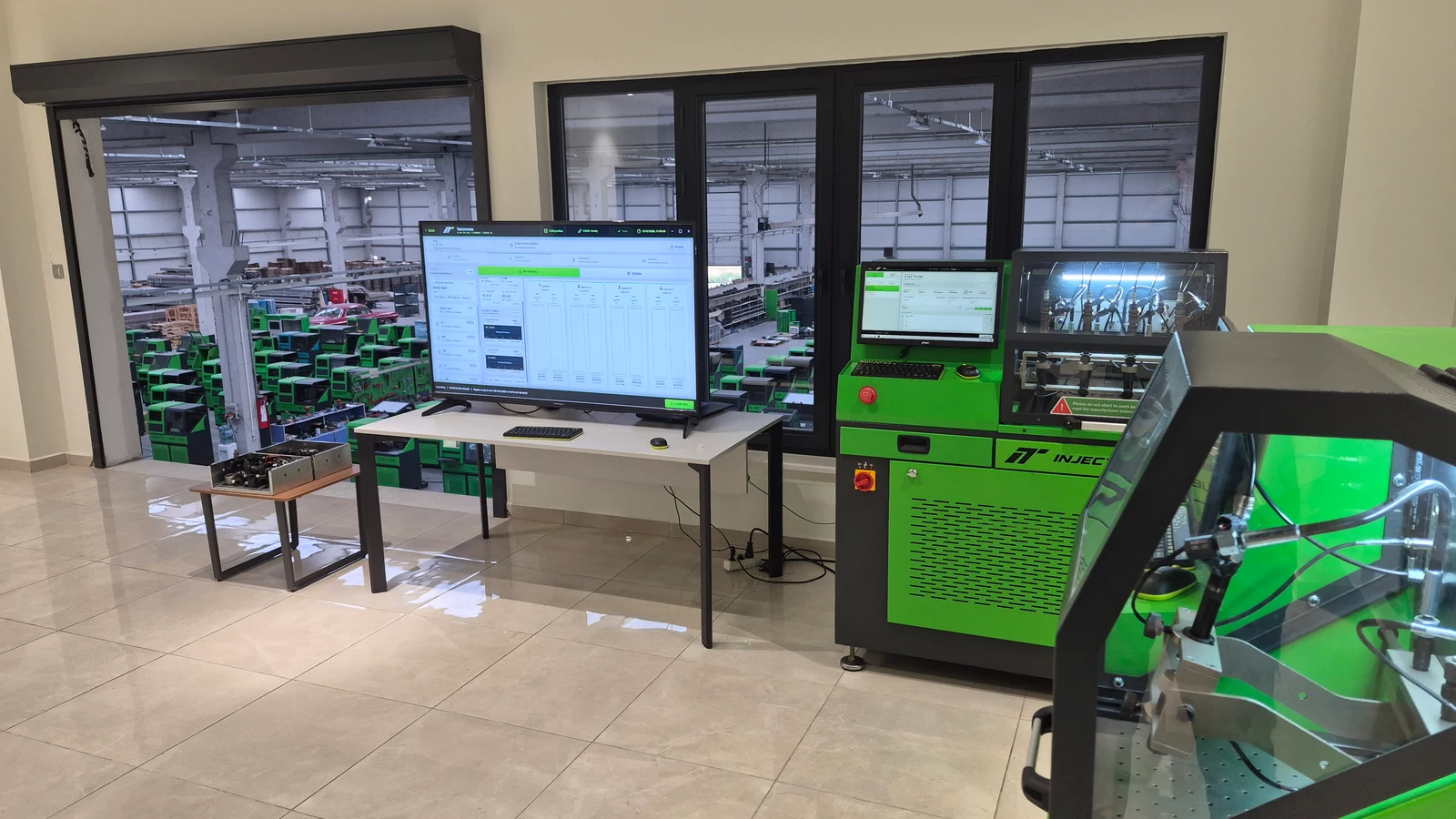
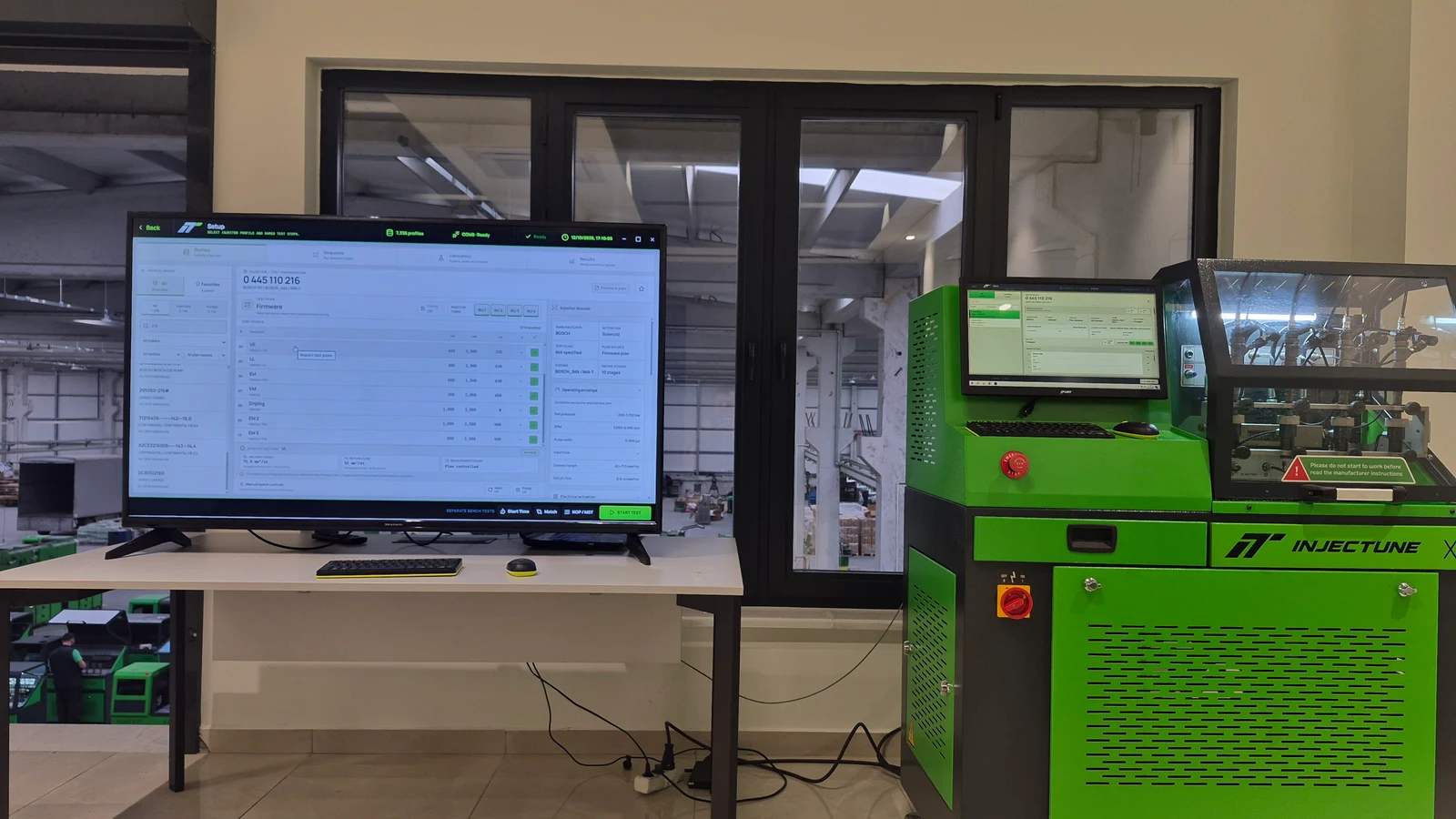
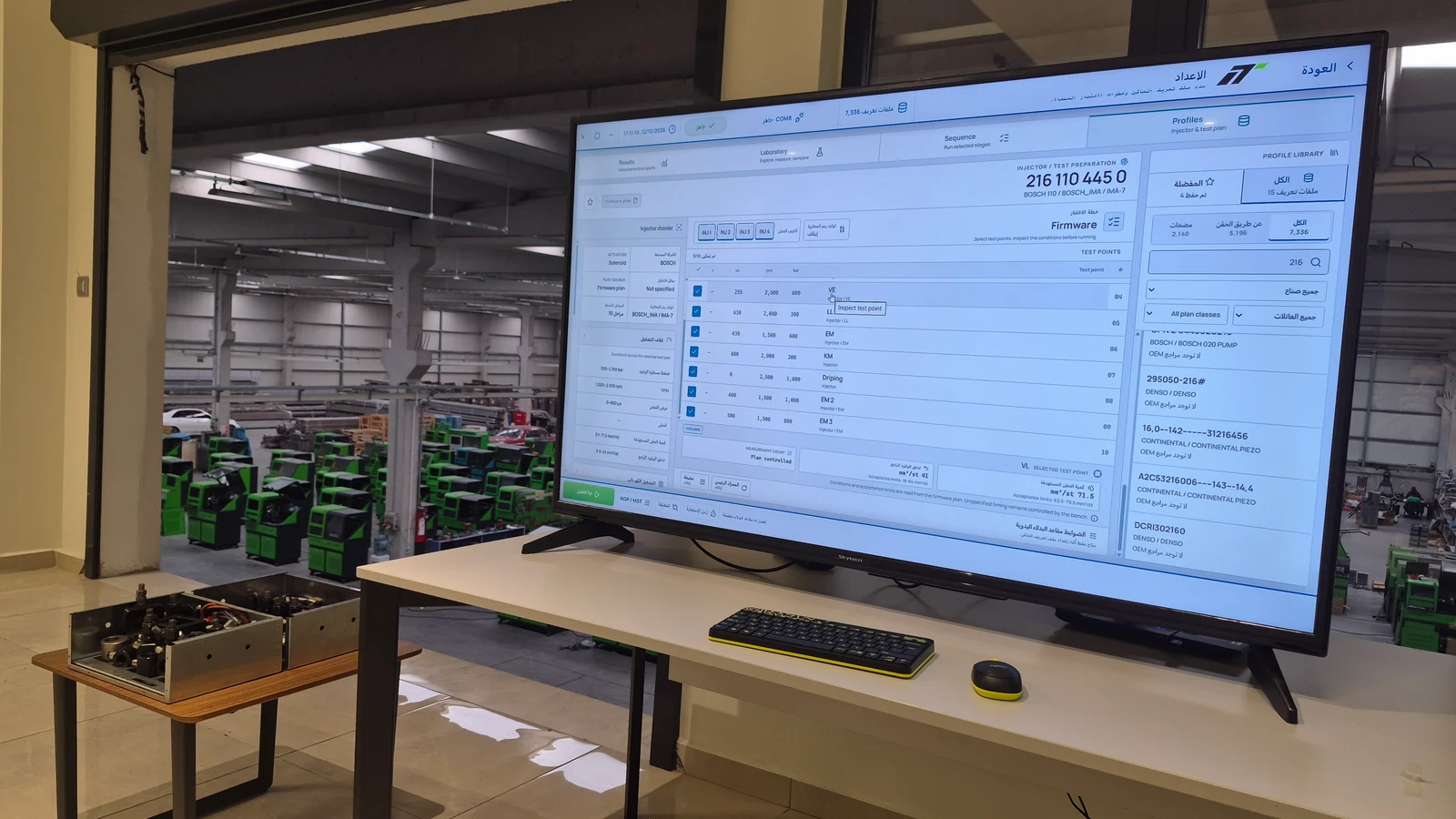
The opening image shows the profile library and selected test points in Injectune software. The measurement view below shows a later part of the workflow, with delivery and back-leak readings separated by channel. Read these as connected records: which application was selected, which step ran, under which conditions, and what result was retained. A live display is useful during testing; the final report should also identify the injector and completed procedure.
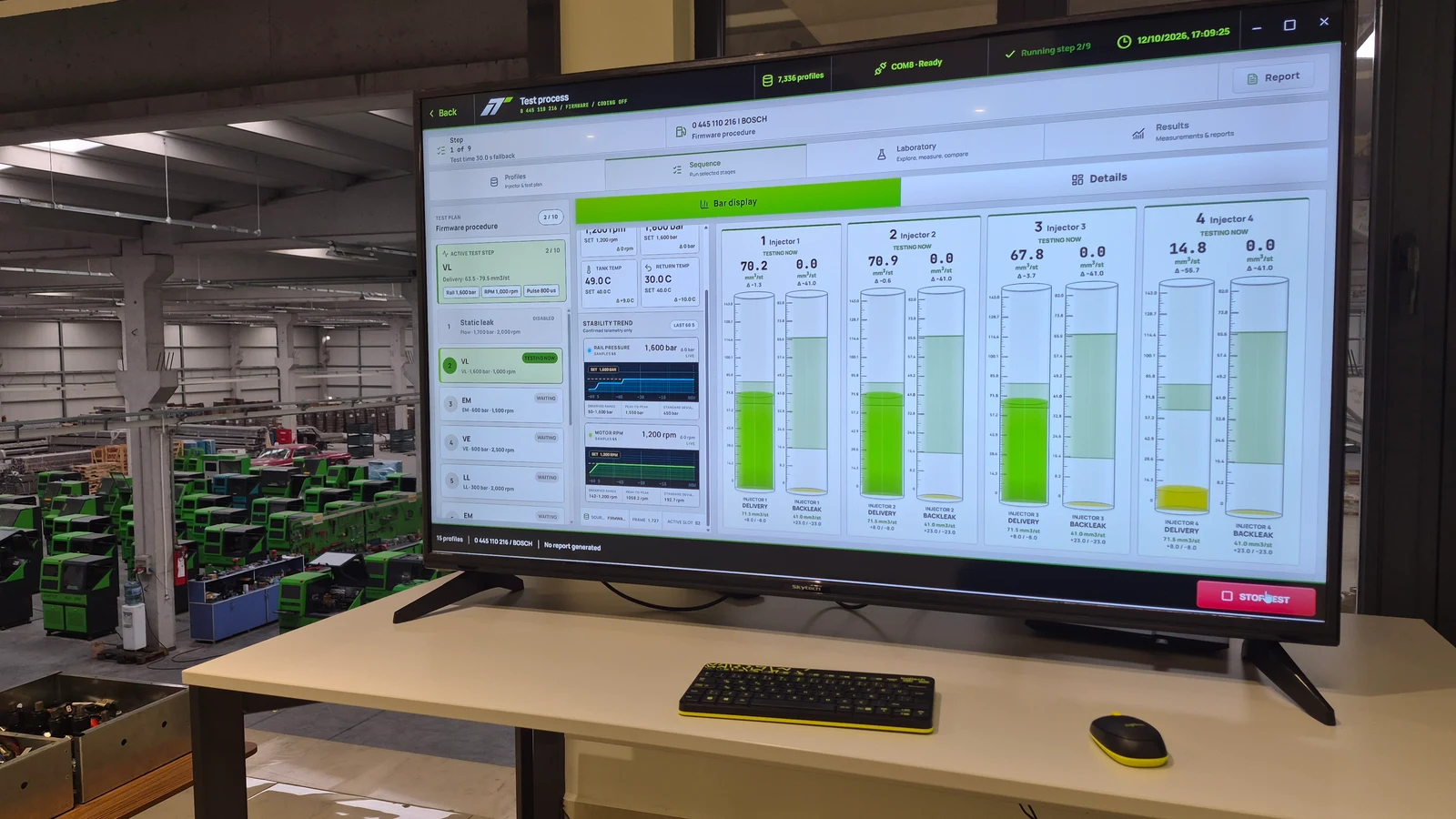
Test plan, profile, code or report?
Software terminology varies. Ask what a selectable “profile” actually contains rather than assuming the name guarantees complete testing and coding coverage.
| Item | What it describes | What to verify |
|---|---|---|
| Test plan | A sequence of operating points, measurements and applicable acceptance criteria | Exact injector application, plan source and revision |
| Drive or control profile | Electrical actuation settings for an injector type | Compatibility with the injector and installed equipment |
| Coding procedure or profile | The supported characterisation and calculation workflow | Whether it produces the required code for this application |
| Individual correction code | Compensation information for a particular injector | Its association with that unit and the vehicle installation procedure |
| Test report | Recorded results from a particular test | Identity, conditions, units, limits and completion status |
Bosch's piezo accessory instructions, section 3.2 illustrate the distinction: control profiles and predefined steps can exist without the required acceptance data. They also warn that unsuitable test values can damage an injector. A compatible connector and a runnable sequence are not sufficient reasons to improvise a test.
Match the injector before comparing results
Record the complete part number, manufacturer, individual identifier where present and relevant modification markings. Select the application specified by the equipment documentation; do not substitute a nearby part number because the housing looks similar.
Keep the plan identifier and available revision information with the result, including the software or database version. Hartridge's software download centre confirms that updates include revised test-plan libraries. Our practical recommendation is to preserve that version context when comparing an earlier report with a retest: a changed procedure needs explanation before a changed result can be interpreted.
The public Injectune injector database helps identify applications. Confirm the actual installed test and coding coverage separately.
Read pressure, timing and quantity together
Common rail systems control injection timing and quantity while pressure generation is separate from injection. Consequently, a delivery figure needs its operating conditions to be meaningful. A short command at one pressure is not interchangeable with a longer command at another. This follows from the system architecture described in Bosch's common rail overview.
For each test step, distinguish the commanded conditions from the measured outputs:
- Rail pressure and pulse width describe the operating point. Check the pressure unit and whether the displayed figure is a target or measured value.
- Delivery is the quantity discharged through the nozzle during the defined measurement. Read its unit, not just the number.
- Return, backleak or leak-off is a separate measurement of fluid returning from the injector. It must be assessed against that step's own conditions and limits.
- Response time describes a measured response, not the commanded pulse duration. Use the software's definition of the timing interval.
For a concrete units example, the Hartridge Sabre CRi Expert brochure lists delivery in mm³/stroke, backleak in mL/min and response in microseconds. Those numbers cannot be compared as though they represented the same quantity. Preserve injection frequency and collection duration wherever the procedure uses them.
Temperature belongs in the assessment
Check the specified test fluid, temperature conditions, stabilisation and any required cooling. Hartridge explains that heat during DENSO backleak testing can affect accuracy and identifies injector-body cooling as a requirement for certain Delphi F2 plans. This is a useful example of why “same pressure” does not necessarily mean “same test.” Follow the applicable requirements, not a universal temperature copied from another application. See the HJ088 cooling documentation.
What makes a pass/fail result meaningful?
A pass needs an identified criterion. Check the measured value against the applicable lower and upper limits, or the stated one-sided limit, for that exact step. A blank limit is not automatically a pass.
Bosch explicitly states that certain EPS 200/205 sample sequences for Delphi and DENSO injectors contain predefined steps without injection and return setpoints or tolerances. The missing data must be supplied separately. This is a specific documented example, not a claim about every database. See Bosch supplementary-set instructions, section 3.2.
A graph helps reveal differences, but does not establish which limits apply. Likewise, advertised maximum pressure is only one equipment characteristic. Hartridge's CRi-Pro documentation distinguishes pressure and flow capability, application coverage and authorised versus all-makes functionality. For purchasing questions, use our diesel injector test bench selection guide.
A practical report-reading checklist
Before releasing a result, ask:
- Which injector? Can this report be traced to the physical unit and, when relevant, its cylinder position?
- Which procedure? Are the selected application, plan source and available revision recorded?
- Which conditions? Are operating points and relevant fluid, temperature and return conditions identifiable?
- Which criteria? Are values, units and applicable limits visible without relying solely on coloured bars?
- Was it complete? Are skipped steps, interruptions and warnings distinguishable from completed checks?
- Which outcome? Are the diagnostic result, any repair or retest, and any coding output clearly separated?
These are editorial review questions, not replacement test specifications. Bench operation requires trained personnel following the equipment and injector procedures.
Where coding fits
Delphi's injector repair guidance distinguishes testing from generating calibration information for ECU injection control. Treat the code as a separate output, not as a substitute for the measured report. Our diesel injector coding guide explains the application-specific workflows.
Injectune's documented capabilities include graphical delivery and spill measurement, S-Time response monitoring, injector-specific automatic or manual testing, and saveable or printable reports. Listed coding families include Bosch IMA and ISA, Delphi C2i/C3i/C4i, Continental/Siemens IIC and DENSO QR; exact availability depends on the injector, installed software, database and configuration. Use the technical documentation to connect those capabilities to the application being assessed.
Frequently asked questions
Does the bench's maximum pressure define the test pressure?
No. Use the selected plan's operating points. The hardware rating is not an instruction to test every injector at the machine's maximum pressure.
Is a selectable coding profile an injector's code?
No. It identifies a supported procedure or application in the software. The individual correction code is separate information associated with the injector.
Can reports from different benches be compared?
First establish whether they use equivalent applications, procedures, conditions, units and criteria. If those differ or are missing, ask for clarification before treating the numerical difference as an injector fault.
Sources
- Bosch: EPS 200/205 piezo accessory instructions, section 3.2
- Hartridge: software and test-plan library updates
- Bosch: common rail system operation
- Hartridge: Sabre CRi Expert measurement specifications
- Hartridge: HJ088 injector-body cooling requirements
- Bosch: supplementary-set instructions, section 3.2
- Hartridge: CRi-Pro application and operating modes
- Delphi: repair testing and calibration codes
Put the knowledge to work.
Talk to our team about the injector applications and testing workflow for your workshop.
Discuss your configuration